




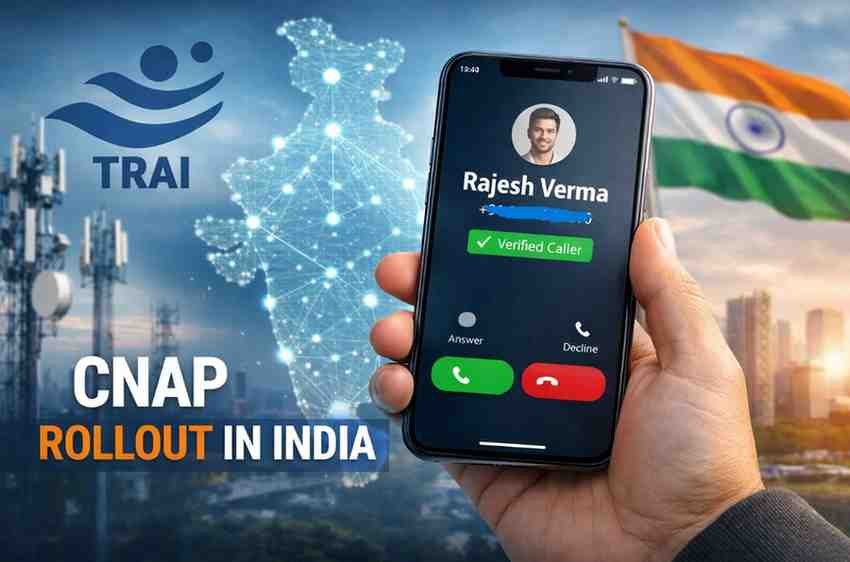
The Telecom Regulatory Authority of India has begun rolling out CNAP, or Calling Name Presentation, a new network-level caller identification system designed to curb the rising number of scam and spam calls in the country. After approving the framework in October 2025, TRAI initiated live testing last month, with a phased rollout now underway across telecom networks.
According to the regulator, CNAP is expected to become widely available over the next few months. Most users are likely to start seeing verified caller names on their phone screens by March or April 2026.
The move comes at a time when phone-based fraud has sharply increased, with scam callers frequently impersonating banks, delivery services, and government departments. As a result, many users avoid answering unknown numbers altogether. TRAI believes CNAP can help restore trust in voice calls by displaying a verified name for every incoming call.
How CNAP works and why it is different
Unlike third-party caller ID apps, CNAP pulls caller information directly from telecom operators’ KYC-verified databases. These records are created when users obtain a SIM card using officially approved identity documents such as Aadhaar. The name shown during a call is therefore intended to reflect the legal identity linked to that number, rather than a label generated through user reports or crowdsourced data.
Telecom companies started testing CNAP across select networks last month to evaluate real-world performance. The rollout is being carried out in phases, beginning with 4G and 5G subscribers. Older network technologies are expected to be included later. TRAI has also directed smartphone manufacturers to ensure CNAP compatibility on devices within six months of the launch.
CNAP has drawn comparisons with Truecaller, a widely used caller identification app in India. However, the two systems differ significantly in approach. While Truecaller relies on user-submitted and crowd-labeled names that can sometimes be inaccurate, CNAP is built into the telecom network itself. This reduces the risk of impersonation but also limits user control over how names appear.
Reactions to the CNAP rollout have been mixed. Some users have welcomed it as a long-overdue step to tackle fraudulent calls. Others have raised privacy concerns, arguing that showing verified names by default could reduce anonymity in legitimate situations. Questions have also been raised about data accuracy, particularly how quickly telecom operators will correct outdated or incorrect KYC records.
For privacy-conscious users, the existing CLIR or Calling Line Identification Restriction option previously allowed callers to hide their identity. However, early testing suggests some carriers may be restricting this feature, potentially limiting opt-out choices once CNAP is fully live.
TRAI has stated that access to KYC data used for CNAP will be tightly controlled, logged, and restricted solely to caller identification. If implemented as planned, CNAP could make scam calls less effective and bring greater transparency to voice communication. How well it balances security and privacy will become clearer as adoption expands nationwide.
Raed Also: Robert Kiyosaki Says He Will Get Richer as ‘Fake Economy’ Crashes, Backs Bitcoin, Gold and Silver

