





Bitcoin and Ethereum are the two most influential blockchain networks in the digital asset ecosystem. Both emerged from the same foundational idea of decentralized systems, yet they evolved in very different directions.
Understanding Bitcoin and Ethereum is essential for investors, developers, businesses, and anyone exploring blockchain technology. While Bitcoin is often viewed as digital gold, Ethereum is widely recognized as a programmable blockchain that powers decentralized applications.
This article explains the real differences between Bitcoin and Ethereum, their technology, economic models, use cases, risks, and long term relevance.
Core Differences Between Bitcoin and Ethereum
Bitcoin was introduced in 2009 by the pseudonymous creator Satoshi Nakamoto. Its primary purpose was to create a peer to peer electronic cash system that operates without banks or central authorities.
Ethereum was launched in 2015 by Vitalik Buterin and other developers. Its goal was not limited to digital money. Instead, it aimed to build a decentralized computing platform where smart contracts and applications could run without intermediaries.
The difference in vision shaped how both networks developed.
Purpose and Philosophy
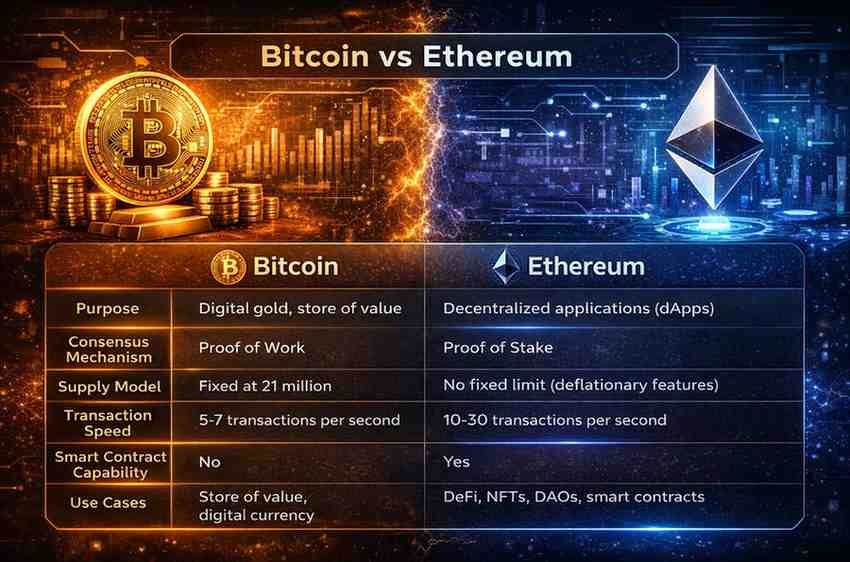
Bitcoin focuses on being a secure, scarce, and censorship resistant store of value. Its design prioritizes stability, decentralization, and security over flexibility.
Ethereum focuses on programmability and innovation. It allows developers to build decentralized finance platforms, NFTs, DAOs, gaming applications, and enterprise solutions.
Technology Architecture
Bitcoin uses a simple scripting language with limited functionality. This design reduces complexity and enhances security.
Ethereum uses a Turing complete programming language that supports smart contracts. This enables complex decentralized applications but also introduces technical risks.
Consensus Mechanism
Bitcoin uses Proof of Work. Miners compete to solve cryptographic puzzles and validate transactions. This system is energy intensive but highly secure.
Ethereum initially used Proof of Work but transitioned to Proof of Stake in 2022 through the Ethereum Merge. Validators stake ETH to secure the network, reducing energy consumption significantly.
Bitcoin has a fixed supply of 21 million coins. This scarcity is a key reason it is compared to gold.
Ethereum does not have a fixed maximum supply. However, after upgrades like EIP 1559 and Proof of Stake, ETH issuance has become more controlled, and in some periods Ethereum has become deflationary.
Use Cases and Real World Adoption
Bitcoin and Ethereum serve different roles in the blockchain ecosystem. Their adoption patterns reflect these roles.
Bitcoin Use Cases
Bitcoin is widely used as:
- Store of value similar to gold
- Hedge against inflation
- Cross border payments
- Institutional investment asset
- Reserve asset for companies and funds
Major institutions, hedge funds, and public companies hold Bitcoin as part of their treasury strategy. Countries like El Salvador have also adopted Bitcoin as legal tender, although adoption remains limited globally.
Bitcoin’s simplicity and security make it attractive for long term wealth preservation.
Ethereum Use Cases
Ethereum powers a wide range of decentralized applications including:
- Decentralized finance platforms such as lending, borrowing, and trading
- NFTs and digital collectibles
- Stablecoins like USDT and USDC
- Decentralized autonomous organizations
- Web3 applications and gaming
- Enterprise blockchain solutions
Most blockchain innovation happens on Ethereum or Ethereum compatible networks. Developers choose Ethereum because of its smart contract functionality and large ecosystem.
Adoption Trends
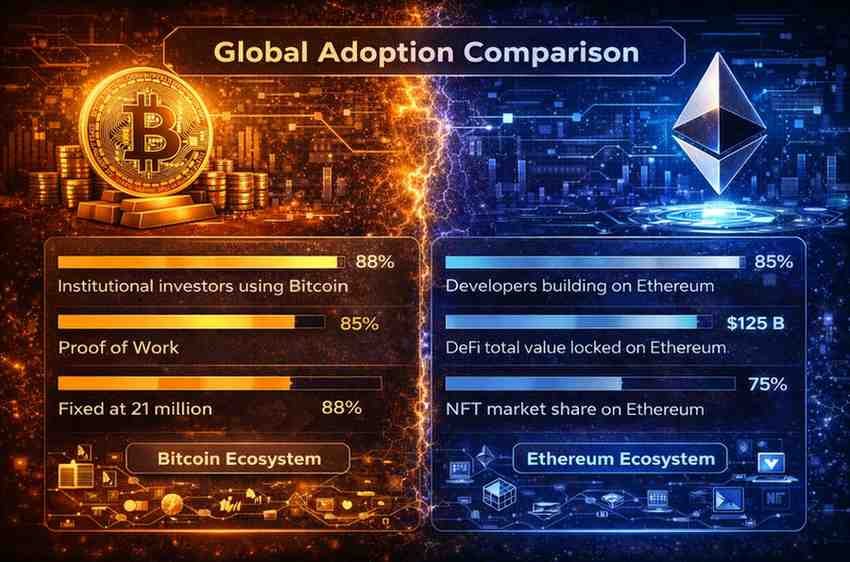
Bitcoin adoption is driven mainly by investors and institutions.
Ethereum adoption is driven by developers, startups, and decentralized communities.
This difference explains why Bitcoin dominates market capitalization while Ethereum dominates application development.
Performance, Scalability and Economic Design
Transaction Speed and Fees
Bitcoin processes around 5 to 7 transactions per second on its base layer. Transaction fees rise during periods of high demand.
Ethereum processes more transactions but also faces congestion during peak usage. Gas fees can become expensive during high network activity.
Both networks are addressing scalability through Layer 2 solutions.
- Bitcoin uses Lightning Network for faster payments.
- Ethereum uses rollups and Layer 2 chains like Arbitrum, Optimism, and zkSync.
Security and Decentralization
Bitcoin is considered the most secure blockchain network due to its hash power and long operational history.
Ethereum is also secure but has experienced more smart contract vulnerabilities because of its complex ecosystem.
Decentralization levels differ:
- Bitcoin prioritizes decentralization at the protocol level.
- Ethereum balances decentralization with innovation and scalability.
Monetary Policy
Bitcoin’s halving events reduce block rewards every four years. This predictable supply schedule strengthens its narrative as a scarce asset.
Ethereum’s monetary policy is more dynamic. EIP 1559 introduced token burning, reducing ETH supply during high network usage.
This difference influences how investors view both assets.
Risks and Challenges
Bitcoin and Ethereum face different risks.
Bitcoin Risks
- Regulatory uncertainty in some countries
- Environmental criticism due to mining
- Limited functionality compared to programmable blockchains
- Market volatility
Ethereum Risks
- Smart contract vulnerabilities
- Competition from other Layer 1 blockchains
- Complexity of upgrades
- Regulatory scrutiny on DeFi and staking
Both networks are also affected by macroeconomic factors such as interest rates, inflation, and global financial conditions.
Long Term Outlook
The future of Bitcoin and Ethereum depends on how blockchain technology integrates with the global economy.
Bitcoin is likely to remain the dominant store of value in the crypto market. Its simplicity and scarcity make it attractive for institutional investors and long term holders.
Ethereum is likely to remain the backbone of decentralized applications. Its developer ecosystem and continuous upgrades position it as a foundational layer for Web3.
Rather than competing directly, Bitcoin and Ethereum may coexist as complementary technologies.
Bitcoin represents monetary decentralization.
Ethereum represents computational decentralization.
Understanding Bitcoin vs Ethereum is not about choosing one over the other. It is about recognizing their distinct roles in the digital economy.
Conclusion
Bitcoin and Ethereum were built with different visions, architectures, and economic models. Bitcoin focuses on security, scarcity, and financial sovereignty. Ethereum focuses on programmability, innovation, and decentralized applications.
Their differences define the structure of the modern blockchain ecosystem.
For investors, Bitcoin often represents stability and long term value storage. For developers and businesses, Ethereum represents opportunity and technological innovation.
As blockchain adoption grows, the relationship between Bitcoin and Ethereum will continue to shape the future of digital finance and decentralized technology.
Read Also: What is Blockchain? A Clear and Practical Guide to How Blockchain Works

