




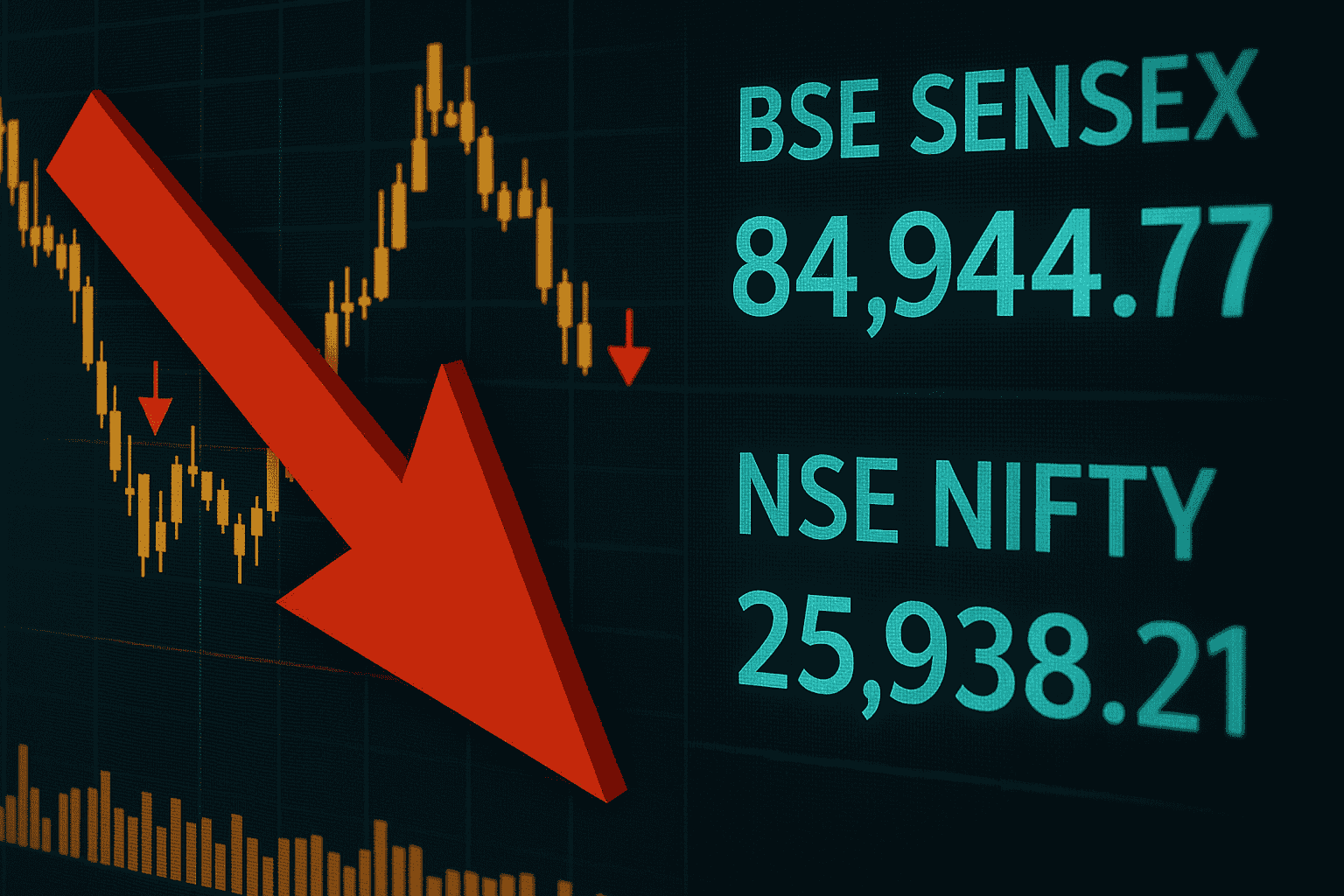
Indian equity markets dropped sharply on Monday as global and domestic risks weighed on investor sentiment. The S&P BSE Sensex fell over 700 points to around 84,990 by early afternoon, while the NSE Nifty50 slipped more than 250 points to about 25,936. The sharp decline quickly raised the question of why market is down today, as selling pressure spread across sectors and broader markets.
Mid cap and small cap stocks underperformed, signalling deeper weakness beyond benchmark indices. Intraday volatility also increased sharply, reflecting heightened nervousness on Dalal Street.
FII outflows remain the biggest drag
One of the most important factors explaining why market is down today is persistent foreign institutional investor selling. According to V K Vijayakumar, Chief Investment Strategist at Geojit Financial Services, steady depreciation in the rupee has pushed FIIs to reduce exposure to Indian equities.
A weakening currency reduces returns for global investors and makes emerging markets riskier in comparison with developed markets. As a result, consistent FII outflows have kept pressure on both Sensex and Nifty.
Vijayakumar also highlighted another global factor. Japanese bond yields have risen sharply, which increases the risk of unwinding the yen carry trade. If global investors start reducing leveraged positions linked to Japanese rates, emerging markets like India may see additional outflows. This has added to near term uncertainty.
He noted that the combination of currency weakness, global bond yield movements and institutional selling can keep volatility elevated in the coming sessions.
Strong fundamentals but short term risks
Even as analysts outline why market is down today, most agree that India’s medium term fundamentals remain strong. The economy posted 8.2 percent GDP growth in the second quarter. The Reserve Bank of India has revised its FY26 GDP forecast upward to 7.3 percent.
Although lower inflation has temporarily slowed nominal GDP growth and impacted near term corporate earnings, leading indicators suggest that around 15 percent earnings growth is achievable in FY27. Analysts believe this is supportive for equity valuations over the long term.
Sectorally, PSU banks were the biggest losers, followed by real estate and chemical stocks. Profit booking in interest rate sensitive pockets added to the downward momentum.
For now, markets are reacting to both domestic strength and global fragility. Currency fluctuations, external risk factors and FII behaviour may keep volatility high in the short term, even though long term fundamentals remain intact.
Conclusion
The sell off provides a clear picture of why market is down today. While India’s economic outlook remains constructive, the near term environment is dominated by global risks, FII withdrawals and currency pressure. Analysts expect volatility to continue until global yields stabilise and fund flows turn positive again.
Read Also: Coinbase returns to India as user onboarding resumes after two year market exit

