





The United States Office of the Comptroller of the Currency has confirmed that a US bank can intermediate cryptocurrency transactions as a riskless principal, allowing traditional banks to take a step closer to offering regulated crypto brokerage services. The clarification was issued in an interpretive letter released on Tuesday, outlining how national banks may participate in crypto trades without holding digital assets on their balance sheets.
Under this structure, a bank can act as a principal in a crypto transaction with one customer while entering an offsetting trade with another customer. This mirrors a long standing activity in traditional markets where banks facilitate trades without assuming market exposure.
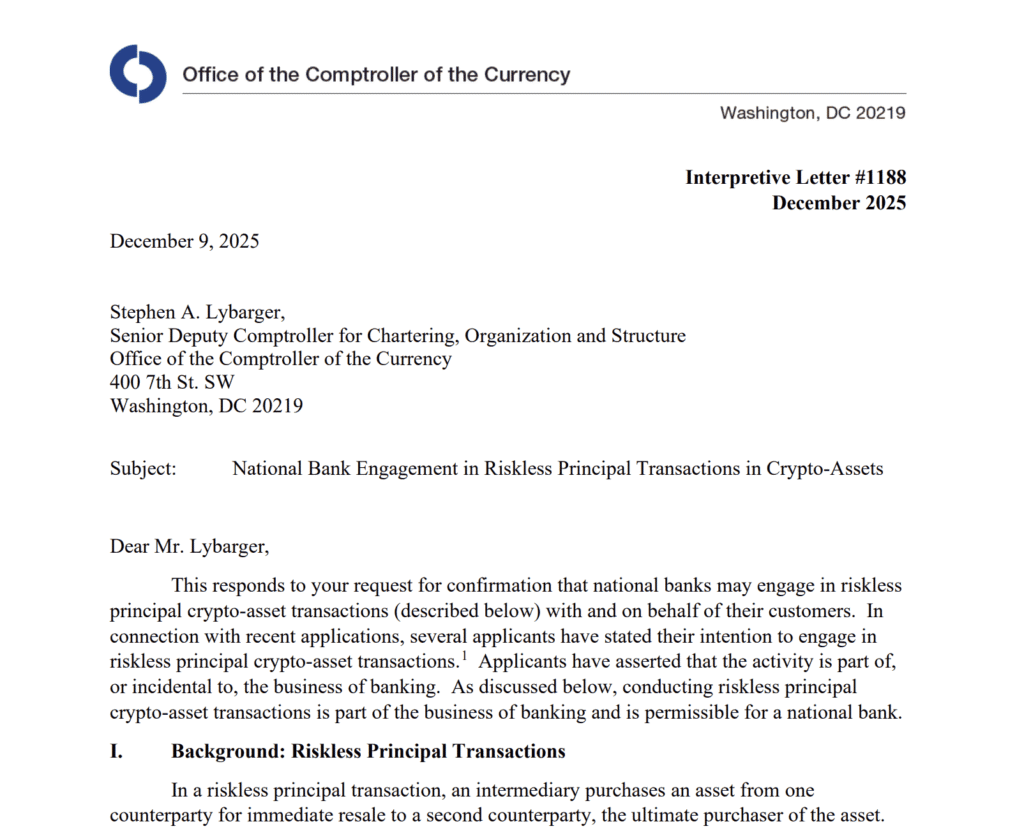
The OCC noted that several applicants seeking federal charters had proposed using this model to expand customer access to crypto services. Allowing a US bank to serve as a regulated intermediary, the agency said, could provide users with an alternative to non regulated or lightly regulated crypto platforms.
OCC outlines risk controls and legal expectations
In the letter, the regulator emphasized that banks must ensure any crypto activity complies with existing law and falls within their chartered powers. Institutions are required to maintain strong procedures for monitoring operational, compliance and market risks.
The OCC highlighted counterparty credit risk, particularly settlement risk, as the main concern in riskless principal crypto transactions. However, the agency noted that managing this type of risk is already integral to the business of banking and that national banks are experienced in overseeing it.
The guidance cites 12 U.S.C. § 24, which already permits national banks to conduct riskless principal transactions as part of core banking activity. The letter also distinguishes crypto assets that qualify as securities, reiterating that transactions involving securities have long been considered permissible.
Importantly, the interpretive letter does not establish new regulations. Instead, it reflects the agency’s nonbinding view of what existing law allows. Its release came a day after OCC chief Jonathan Gould said that crypto firms applying for bank charters should be treated the same as traditional financial institutions.
Gould stated that the banking system has the capacity to evolve and that there is no basis for treating digital assets differently. He pointed out that banks have offered electronic custody services for decades, reinforcing that digital asset activity fits within established banking functions.
Policy shift from earlier regulatory posture
This development marks a shift from the regulatory environment under the previous administration. During the Biden presidency, some industry groups and lawmakers accused regulators of unofficially discouraging banks from working with crypto companies. Critics referred to this as “Operation Choke Point 2.0,” arguing that federal agencies applied heightened scrutiny to digital asset activity.
Since President Donald Trump took office in January, federal agencies have adopted a more permissive stance. The OCC’s latest guidance reflects that change, underscoring a broader policy shift toward integrating digital asset activity into the traditional banking sector.
Conclusion
The OCC’s clarification gives a US bank a clearer pathway to offering regulated crypto brokerage services without taking on direct market exposure. As regulatory guidance evolves, national banks may soon play a more central role in providing secure, compliant access to digital assets for mainstream customers.
Read Also: Vivo X300 reviews shows the X300 setting a new benchmark for smartphone photography

