





DeFi investing used to be simple.
You’d open a dashboard, hunt for the highest APY, deploy capital fast, then pray you’d exit before the crowd. Speed trumped understanding. Timing beat structure.
For a while, it worked.
Today? That same strategy quietly bleeds capital more often than it builds it.
Yields haven’t vanished from decentralized finance. New strategies keep emerging. Capital still flows on-chain. But serious DeFi investors now spend far less time discussing headline returns—and far more time dissecting exposure, questioning assumptions, and modeling downside risk.
This shift raises a critical question.
If DeFi yield investing still exists, why has the conversation pivoted from “How much can I earn?” to “What can go wrong?”
The answer lies in how DeFi matured. What started as an experimental frontier evolved into a complex financial ecosystem where risk stopped being abstract. In 2026, DeFi risk management isn’t optional—it’s the foundation of investing itself.
The “Yield Era” of DeFi — What Investors Were Really Chasing

Early DeFi rewarded one thing above all: speed.
Protocols launched with aggressive token incentives. Liquidity mining programs flashed triple-digit APYs. New farms sprouted weekly. Capital rotated frantically from one opportunity to the next.
Yield became the only metric that mattered.
Few investors asked where that yield originated. Fewer still questioned its sustainability.
💡 Pro Tip: When you see APYs above 100%, ask yourself: “Am I earning income, or am I being paid in freshly printed tokens that dilute my actual gains?”
Looking back, much of early DeFi yield wasn’t income in any traditional sense—it was dilution dressed up as opportunity. Protocols paid early users with newly minted tokens to bootstrap liquidity and generate buzz. The earlier you arrived, the larger your slice before the pie expanded.
Risk felt distant. Almost theoretical.
Smart contracts were untested. Total value locked was modest. Failures got framed as isolated incidents rather than systemic warnings. When something broke, losses stayed manageable because position sizes were small.
Many early users recognize this pattern: funds deployed late at night into barely audited contracts, incentives too attractive to ignore, exits planned for tomorrow. It felt reckless.
But it worked.
Until it didn’t.
What functioned in an empty market collapsed once real capital arrived.
What Changed? The Hidden Forces Behind the Shift

The mindset shift didn’t happen overnight. It unfolded gradually, driven by several forces reshaping DeFi from within.
Market maturity struck first. As more capital poured in, inefficiencies evaporated. Easy arbitrage closed. Incentive programs attracted liquidity faster than protocols could sustain it. APYs compressed.
Then came higher stakes. Losses stopped being learning experiences—they became career-ending for funds, devastating for individuals, catastrophic for protocol credibility. When positions scale, mistakes stop being theoretical.
Macro conditions added pressure. Traditional finance began offering meaningful yields again. When low-risk government bonds and money market instruments generate solid returns, DeFi yields must justify their additional complexity and uncertainty. The hurdle rate rose.
Security events completed the transformation. Not just high-profile exploits, but quieter failures too: governance errors, oracle breakdowns, wallet drains, sudden parameter changes. Risk stopped being rare. It became continuous.
🎯 Expert Advice: Before deploying capital, always ask: “Would I accept this risk-return profile in traditional finance?” If the answer is no, your DeFi strategy needs adjustment.
At some point, investors began asking a simple question: Would you accept this risk for this return outside crypto?
Once framed that way, most strategies crumbled.
Yield Was Never Free — It Was Payment for Risk
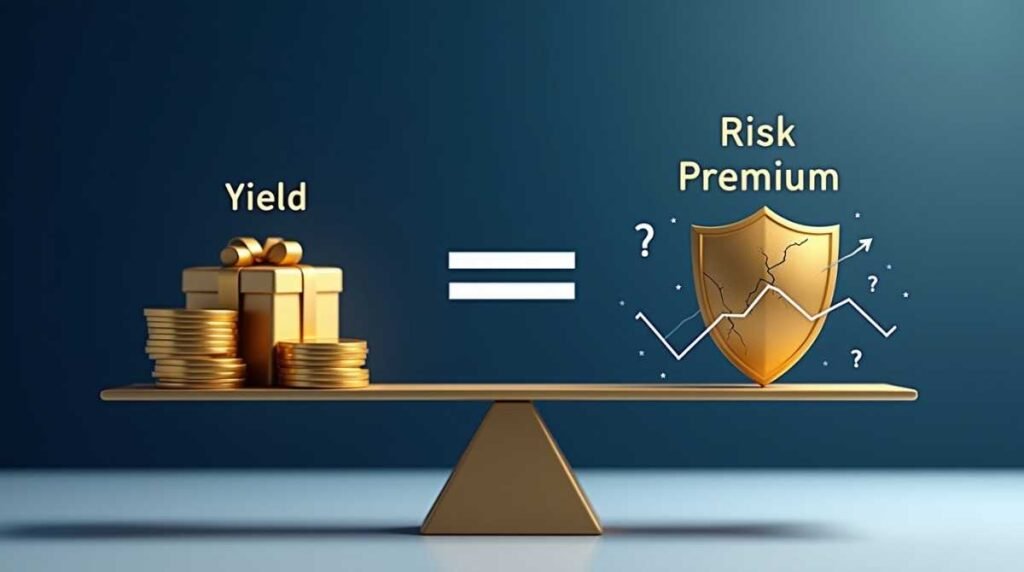
One of the most important realizations in modern DeFi investing: yield was never a gift.
Every APY compensates investors for something specific.
Early users got paid to absorb uncertainty. They accepted smart contract risk before audits became battle-tested. They supplied liquidity before markets stabilized. They trusted governance systems still finding their footing.
Yield was the incentive to participate before clarity existed.
As protocols matured, that uncertainty declined. Systems stabilized. Revenue models improved. And yields—naturally—fell.
The formula is simple:
Yield = Incentive + Risk Premium
When risk hides in shadows, premiums look generous. When risk steps into light, pricing adjusts.
This explains why risk-adjusted yield matters more today than raw APY. A lower return with clearly defined downside often outperforms a higher return that collapses under stress.
💡 Pro Tip: Track the “yield source” for every position. Is it from protocol revenue (sustainable) or token emissions (temporary)? This single distinction predicts longevity better than any APY number.
Sustainable DeFi yield isn’t about maximizing short-term returns—it’s about compensation that accurately reflects the risks being taken.
The New Risk Stack Every DeFi Investor Must Understand
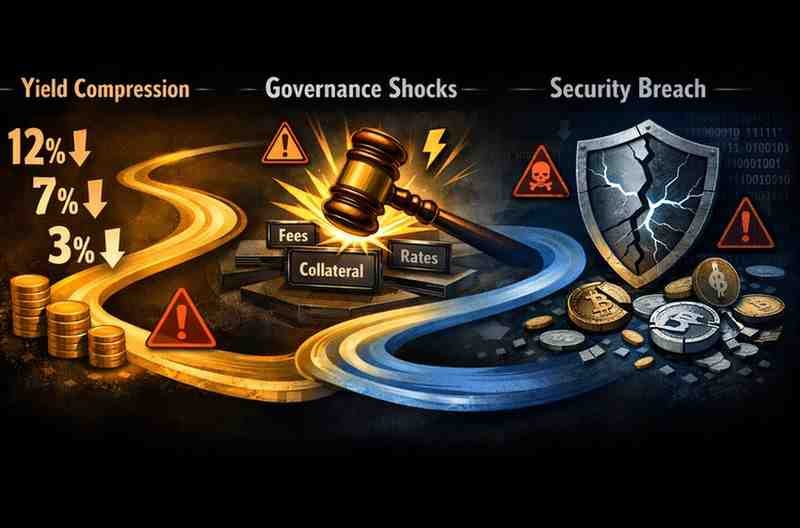
As DeFi matured, risk didn’t disappear. It layered.
Understanding these layers has become mandatory for participation.
Smart contract risk remains fundamental. Bugs, upgrade paths, admin controls—they all matter, even in audited protocols.
Liquidity and exit risk determines whether capital can leave when conditions shift. High utilization rates, withdrawal queues, or thin liquidity can trap investors at precisely the wrong moment.
Market and liquidation risk emerges when collateral values move faster than systems can respond. Volatility transforms leverage into fragility.
Model and assumption risk often gets overlooked. Many strategies depend on funding rates, correlations, or behavioral patterns that fail under stress.
Governance and parameter risk reflects a simple truth: rules can change. Interest rates, collateral thresholds, incentive structures—none are permanent.
Finally, user-level risk has grown significantly. Wallet security, approvals, phishing attacks, signing errors—these now account for a massive share of real-world losses.
🎯 Expert Advice: Create a risk checklist for every new position. Score each layer 1-10. If any single layer scores above 7, either reduce position size or skip entirely. Most losses come from ignoring one critical risk factor.
This framework works because it replaces vague fear with structured understanding. It transforms speculation into analysis.
Case Studies That Quietly Changed Investor Behavior
Several moments reshaped how experienced investors approach DeFi.
Some yield strategies appeared bulletproof until scale arrived. As capital flooded in, returns compressed. Funding dynamics shifted. What once produced attractive yield became marginal—or dangerous. Investors learned that scalability matters as much as design.
Other lessons emerged from governance decisions that altered returns overnight. Protocols adjusted parameters to protect pegs, rebalance incentives, stabilize systems. Investors who assumed yields were fixed discovered otherwise.
Then came the exploits.
Not every exploit made headlines. Some simply eroded confidence. Strategies once labeled “safe” got repriced instantly. Capital demanded higher compensation or fled entirely.
💡 Pro Tip: After any major DeFi event (exploit, governance change, market shock), wait 48-72 hours before making decisions. Initial reactions often overcorrect. The best opportunities and clearest risks reveal themselves after panic subsides.
Across these events, one lesson stayed consistent: understanding risk mattered infinitely more than reacting to numbers.
Experienced investors adapted. They diversified exposure. They capped position sizes. They treated yield as conditional, never guaranteed.
How DeFi Investors Think Today (Compared to Before)
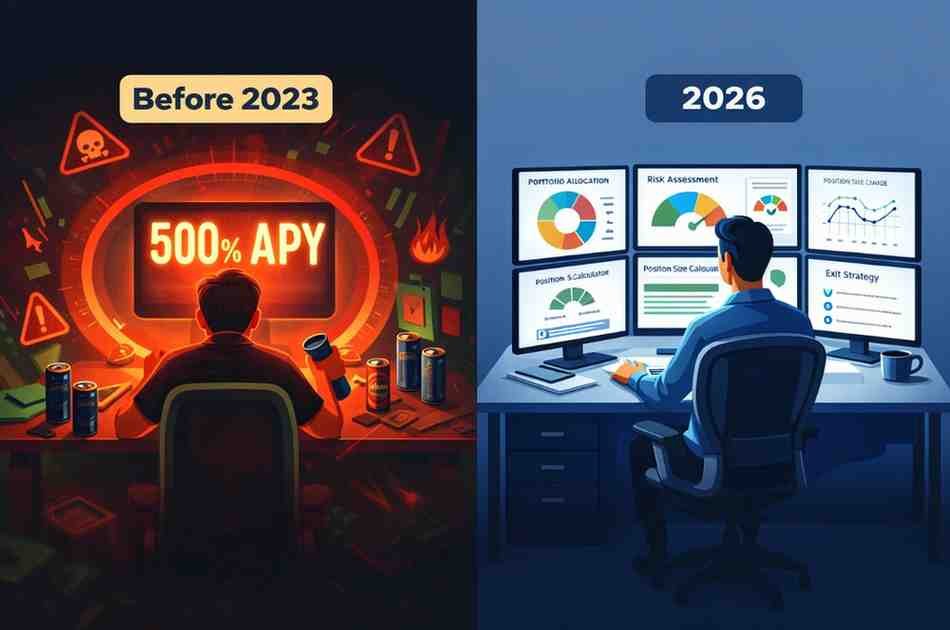
The contrast between early and modern DeFi behavior is striking.
Before: Success meant finding the highest APY and rotating fast. Incentive chasing was the strategy. Risk was background noise.
Today: The mindset has transformed.
Exposure limits matter. Capital gets distributed across strategies. Downside scenarios get modeled. Exit liquidity gets assessed before entry.
Risk management became the new alpha.
This doesn’t mean investors turned conservative—it means they became deliberate. They understand that survival compounds better than bravado.
🎯 Expert Advice: Implement the “3-position rule”: Never let any single DeFi position exceed 33% of your total crypto portfolio. This single constraint has saved more capital than any sophisticated risk model.
A useful self-check is simple: Which mindset do you still recognize in your own strategy?
What This Shift Means for the Future of DeFi
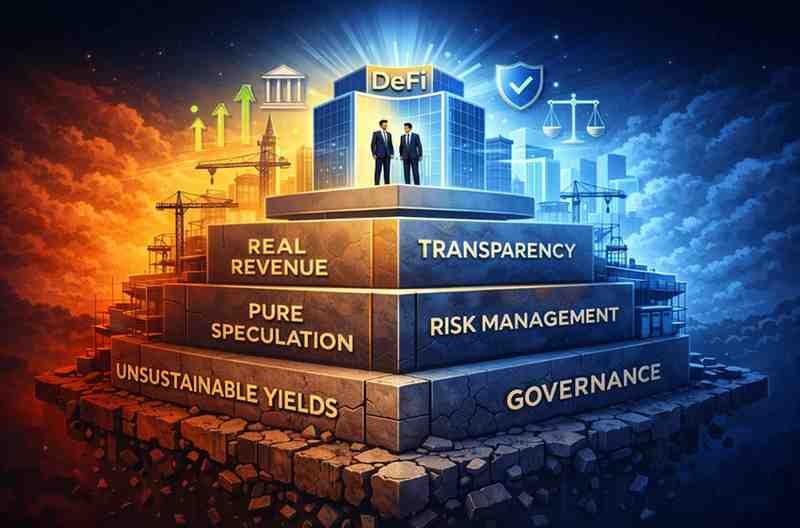
Lower yields don’t signal a weaker DeFi ecosystem. They signal a healthier one.
As risk gets priced more accurately, protocols face pressure to develop real revenue models. Governance improves. Transparency increases. Fragile designs get exposed sooner.
This environment attracts long-term capital. Institutions care less about peak APY and more about reliability, controls, downside protection.
Sustainable DeFi isn’t built on excitement—it’s built on trust earned through resilience.
The future of DeFi investing belongs to those who treat it as a financial system, not a casino.
Yield Didn’t Disappear — It Got Honest
DeFi didn’t lose yield. It gained perspective.
Risk no longer hides behind dashboards and token incentives. It’s visible, measurable, increasingly priced into returns.
Long-term participation now favors understanding over speed. Structure over hype.
In decentralized finance, yield isn’t a promise—it’s a contract.
And risk is always part of the signature.
💡 Final Pro Tip: Before entering your next DeFi opportunity, ask three questions: (1) What’s the yield source? (2) What breaks this strategy? (3) Can I exit in 24 hours if needed? If you can’t answer all three confidently, you’re speculating, not investing.
Before entering your next DeFi opportunity, ask yourself one final question:
Do you still chase yield, or do you price risk first?
Read Also: “Web3 Is Not Early Anymore—It’s Fragmented”

