




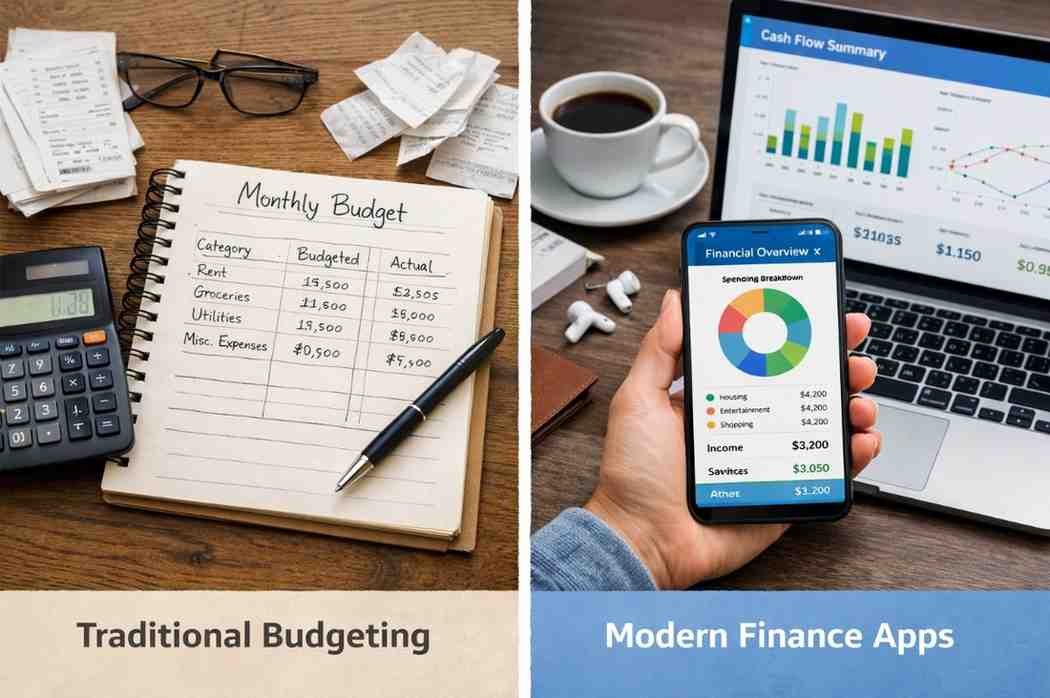
For years, Traditional Budgeting has been treated as the foundation of personal finance. Track income, assign fixed categories, control spending, repeat every month. On paper, the system looks logical and disciplined. In reality, many people in 2025 are finding that it no longer fits how money actually moves through their lives.
Rising living costs, unpredictable income streams, subscription based expenses, instant digital payments, and side hustles have reshaped financial behavior. The problem is not that people stopped caring about money. The problem is that Traditional Budgeting assumes stability in a world that has become fluid.
Search trends, financial app data, and consumer behavior studies show a clear pattern. People are abandoning rigid monthly budgets not because they are careless, but because the old methods fail under modern pressure. The shift is not toward reckless spending. It is toward adaptive money management.
This article explains why Traditional Budgeting is breaking down in 2025 and what practical alternatives people are actually using instead.
Table of Contents
Why Traditional Budgeting Is Breaking Down in 2025

The core flaw of Traditional Budgeting is not discipline. It is assumption. It assumes predictable income, stable expenses, and linear financial goals. None of these assumptions hold true for a large portion of the population today.
Income volatility is now mainstream. Freelancers, creators, gig workers, commission based professionals, and even full time employees face fluctuating cash flow. Traditional Budgeting depends on knowing exactly how much money will arrive each month. When income changes week to week, fixed category budgeting becomes stressful instead of helpful.
Expenses have also changed shape. Subscriptions, automatic renewals, digital services, cloud tools, streaming platforms, AI software, fitness apps, and micro payments do not fit neatly into old budget categories. People are often surprised not by large purchases but by the accumulation of small recurring charges. Traditional Budgeting struggles to surface these patterns clearly.
Inflation has added another layer of friction. Prices in groceries, housing, healthcare, education, and transport no longer stay stable long enough for annual or even quarterly planning. A budget created in January may feel outdated by March. This constant adjustment creates fatigue, causing many users to abandon the process entirely.
There is also a psychological cost. Traditional Budgeting frames spending as success or failure. Go over a category and the system signals a mistake. Research in behavioral finance shows that this guilt based structure often leads to avoidance rather than improvement. People stop checking budgets precisely when they need clarity the most.
Digital money has changed behavior as well. Cash spending once created friction that enforced awareness. Today, contactless payments, wallets, and in app purchases remove that pause. Traditional Budgeting was designed for a slower transaction environment. It does not account for the speed and invisibility of modern spending.
Most importantly, Traditional Budgeting is reactive. It looks backward at what was spent instead of forward at what flexibility is required. In a year like 2025, flexibility has become more valuable than precision.
What People Are Using Instead of Traditional Budgeting
People are not abandoning financial responsibility. They are replacing Traditional Budgeting with systems that match how money actually flows today.

The most common shift is toward cash flow based planning. Instead of assigning strict categories, individuals track incoming and outgoing money in real time. The focus moves from monthly perfection to weekly awareness. This approach allows adjustments as income and expenses change without triggering failure signals.
Another growing method is priority based spending. Instead of budgeting every category, people identify three to five financial priorities such as rent, savings, debt reduction, health, or learning. Money flows first to these priorities. Everything else becomes flexible. This method reduces mental load while still protecting long term goals.
Zero based budgeting is evolving as well. In its modern form, it is no longer a rigid spreadsheet exercise. Apps and banking tools now automate allocation dynamically. Money is assigned as it arrives rather than predicted in advance. This makes the model usable even for irregular earners.
Sinking funds have also returned in a digital form. Instead of monthly categories, people create rolling funds for travel, emergencies, annual bills, and large purchases. Contributions adjust based on current cash flow rather than fixed targets. This reduces shock expenses, one of the biggest failure points of Traditional Budgeting.
Automation is playing a larger role. Savings, investments, and bill payments are increasingly automated to remove decision fatigue. People are designing systems where good financial behavior happens by default, not through constant willpower.
There is also a visible shift toward financial visibility over control. Dashboards that show net worth, burn rate, runway, and spending velocity are replacing detailed category budgets. People want to know how long their money will last, not whether dining out exceeded an arbitrary limit.
Mental health awareness has influenced this transition. Financial systems that reduce anxiety, shame, and avoidance are outperforming those that promise discipline through restriction. Modern money management emphasizes adaptability, not punishment.
This does not mean Traditional Budgeting is obsolete for everyone. Stable income households with predictable expenses may still find it useful. The difference in 2025 is that it is no longer the default solution for the majority.
The New Philosophy of Money Management
At its core, the move away from Traditional Budgeting reflects a philosophical shift. Money is no longer managed as a fixed monthly equation. It is treated as a living system.

People are planning for uncertainty rather than stability. They are designing buffers instead of categories. They are measuring progress in resilience rather than compliance.
Financial success in 2025 looks less like a perfect spreadsheet and more like sustained flexibility. It is about absorbing shocks without panic, adjusting goals without guilt, and maintaining visibility without obsession.
The most successful systems are simple enough to maintain and adaptive enough to survive change. They prioritize clarity over control.
Traditional Budgeting taught people to account for money. The new systems teach people to respond to reality.
That is why Traditional Budgeting is failing in 2025, not because it was wrong, but because the world it was designed for no longer exists.
Read Also: The Most Overhyped Tech Trends of the Last 5 Years and What Actually Worked

