





Over the past decade, thousands of blockchain projects launched with bold promises.
Decentralized finance would replace banks. Tokens would realign incentives. Distributed ledgers would eliminate the need for trust altogether.
Today, most of those projects no longer exist.
Some quietly stopped shipping updates. Others hemorrhaged users, funding, or relevance. A few collapsed suddenly after security breaches or governance failures. Only a small fraction continue operating in any meaningful way.
This reality raises an uncomfortable question: If blockchain is truly revolutionary, why do so many blockchain projects fail?
The answer has little to do with token prices or short-term market cycles. This isn’t a price-focused article. Instead, it’s a structural, long-term examination of why blockchain startup failure remains so common—and what the surviving projects do differently.
Understanding this distinction matters more than ever.
Section 1: Failure Is the Norm, Not the Exception
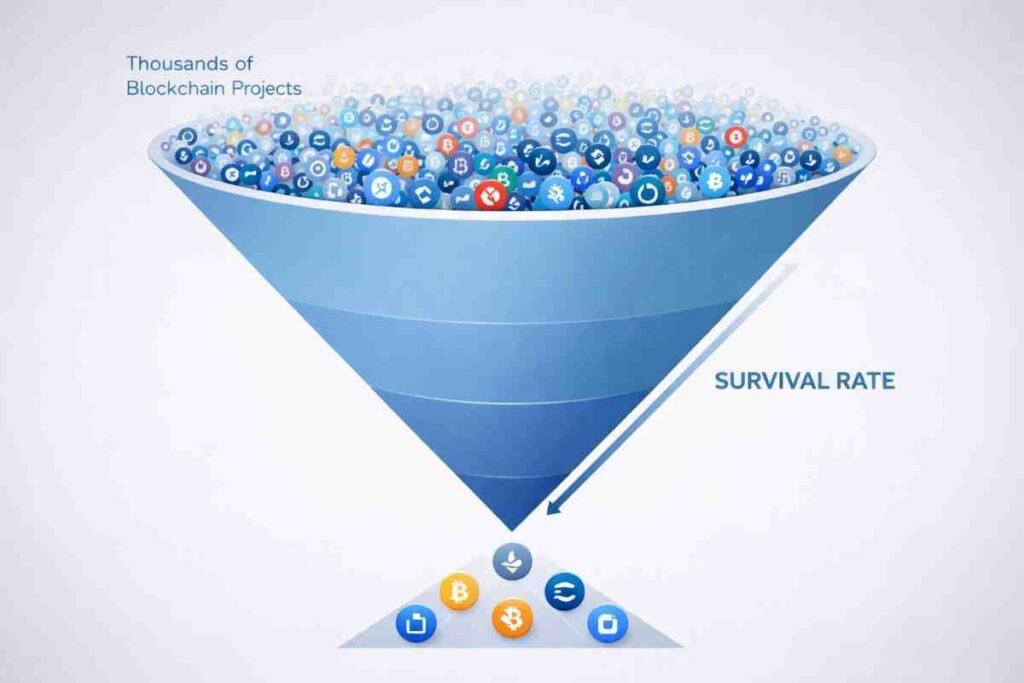
Failure isn’t unique to blockchain.
Most startups fail regardless of industry. Traditional startup data shows the majority of companies shut down within their first five years. Blockchain simply magnifies this pattern.
The blockchain startup failure rate appears higher because launching is easier. Tokens allow teams to raise capital before proving real demand. Hype accelerates visibility. Early traction can resemble success even when the foundation crumbles beneath it.
In the early stages, speculation conceals structural flaws.
Users arrive for incentives rather than utility. Developers join for grants, not long-term ownership. Activity spikes, then fades. When market conditions tighten, weaknesses surface quickly.
💡 Expert Insight: Before investing time or capital in a blockchain project, ask a simple question: “Would I use this product if there were no tokens involved?” If the answer is no, you’re likely looking at a project built on incentives rather than value—and those rarely survive market downturns.
This explains why failed blockchain projects often disappear faster than traditional startups. The margin for error is smaller. Trust erodes far more quickly.
Failure, in this context, isn’t an anomaly—it’s the default outcome.
Section 2: Building Blockchain First Instead of Solving a Real Problem
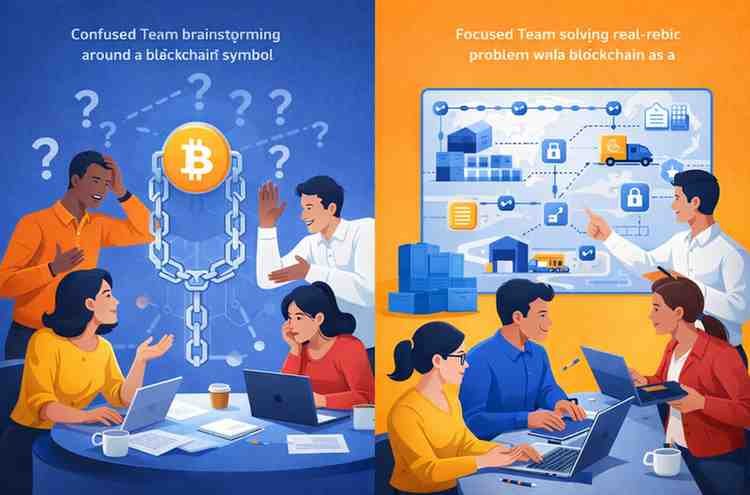
The most common root cause of blockchain project failure is surprisingly simple: the project was built around blockchain rather than around a real problem.
Teams begin with a token, a chain, or a protocol design, then search for a use case that justifies it. In many situations, a traditional database or existing system would have been more effective.
This “solution in search of a problem” mindset creates unnecessary complexity.
Tokens get introduced where incentives add no value. Decentralization gets applied where coordination costs exceed benefits. Users are forced to manage wallets and gas fees for problems they never asked to solve.
🎯 Pro Tip: Apply the “blockchain necessity test” to any project. Ask: Does this problem require immutability, censorship resistance, or trustless coordination? If you can solve it with a standard database, API, or existing infrastructure, blockchain adds cost without adding value. Start with the problem, not the technology.
Early traction can still occur. Airdrops, rewards, and marketing campaigns attract attention. But retention remains low.
When incentives end, usage drops. Product-market fit was never established.
Surviving blockchain projects reverse this sequence. They start with a clearly defined problem and deploy blockchain only when it provides a measurable, defensible advantage.
Section 3: When Adoption Never Arrives

Most blockchain platforms depend heavily on network effects.
A single user gains little value in isolation. The system only functions when enterprises, developers, validators, or institutions participate together. This creates a fragile adoption curve.
Onboarding friction compounds the problem.
Wallet setup, key management, unfamiliar interfaces, and unclear value propositions slow user growth. For enterprises, integration costs and compliance concerns add even more resistance.
Partnership announcements often disguise this reality.
A logo on a website doesn’t equal adoption. Many blockchain initiatives announce pilots that never reach production. Coordination breaks down. Incentives misalign. Momentum stalls.
⚠️ Red Flag to Watch: Be skeptical of projects that announce partnerships without providing concrete usage metrics. Real adoption shows up in transaction volume, active addresses, and developer commits—not press releases. If a project won’t share these numbers, there’s usually a reason.

Several enterprise and infrastructure-focused blockchain projects failed not because the technology was flawed, but because adoption never reached critical mass.
Without sustained participation, even well-designed systems fade into obscurity.
Section 4: Tokenomics That Work in Theory, Fail in Reality
On paper, tokenomics often look elegant.
Emissions attract users. Rewards incentivize behavior. Governance tokens promise decentralization. Models assume rational actors and stable demand.
Reality proves far messier.
High inflation creates constant sell pressure. Users farm rewards without loyalty. When yields decline, activity collapses. The system becomes dependent on continuous incentives just to survive.
This introduces reflexive risk: confidence drives usage, usage supports price, and price reinforces confidence. When one layer breaks, the entire structure can unwind rapidly.
💡 Expert Insight: Sustainable tokenomics should answer three questions: (1) What value does the token capture beyond speculation? (2) What happens to usage when token incentives are reduced by 80%? (3) Is there real demand for the token, or just demand for what the token can be traded for? Projects that can’t answer these clearly are built on sand.
Many crypto incentive models fail because they reward participation without producing lasting value.
Projects that survive treat tokenomics conservatively. They align incentives with genuine usage rather than short-term growth metrics. Tokens support the system instead of replacing it.
Section 5: Security Breaches That Destroy Trust Overnight

In blockchain, trust is fragile. A single exploit can end a project overnight.
Smart contract bugs, wallet drainers, and bridge exploits have drained billions in user funds. Even when teams respond quickly, recovery remains difficult. Lost assets are often unrecoverable. Rollbacks are controversial or technically impossible.
Unlike Web2 platforms, blockchain projects cannot quietly reset accounts or reverse transactions.
Once trust breaks, users leave.
Security failures aren’t viewed as minor technical bugs—they’re seen as fundamental design flaws. Reputation damage spreads rapidly across developer communities and social platforms.
🛡️ Security Checklist: For builders: Never skip multiple independent audits, implement time-locked upgrades, maintain active bug bounty programs, and practice incident response drills. For users: Check if a project has been audited, how long the code has been in production, and whether there’s insurance or recovery mechanisms. New code equals new risk.
This is why security isn’t a feature. It’s a survival requirement.
Projects that last invest heavily in audits, monitoring, bug bounties, and conservative system design. They assume attacks will happen and plan accordingly.
Section 6: Governance Without Accountability
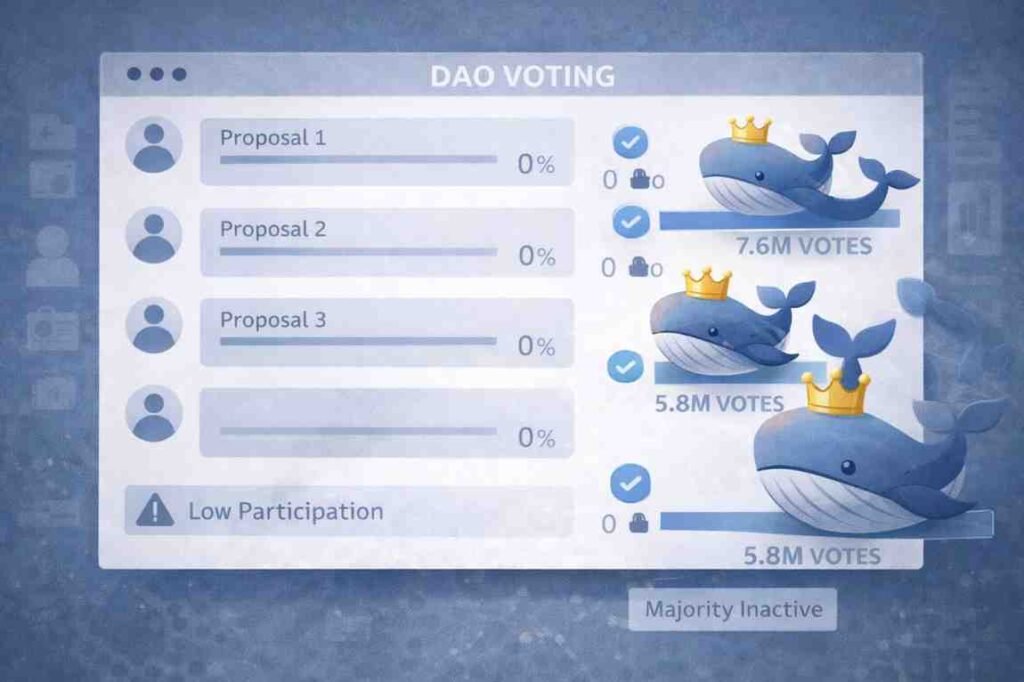
Decentralized governance promises transparency and community control.
In practice, it often falls short.
Participation rates stay low. Most token holders don’t vote. Decision-making power concentrates among whales, funds, or insiders. Critical proposals stall due to low quorum or lack of consensus.
During emergencies, governance becomes a liability.
Security incidents require swift action. Regulatory changes demand fast responses. DAO processes are frequently too slow to adapt.
🎯 Pro Tip: The best governance systems separate routine decisions from emergency responses. Look for projects with clearly defined “circuit breakers”—mechanisms that allow rapid action during crises while maintaining decentralized control for long-term direction. Pure decentralization at launch often means no one can act when it matters most.
This gap between ideal decentralization and operational reality weakens many projects.
Surviving teams design governance systems that balance openness with accountability. They define clear authority during crises while preserving long-term decentralization goals.
Section 7: Regulation, Reality, and External Pressure
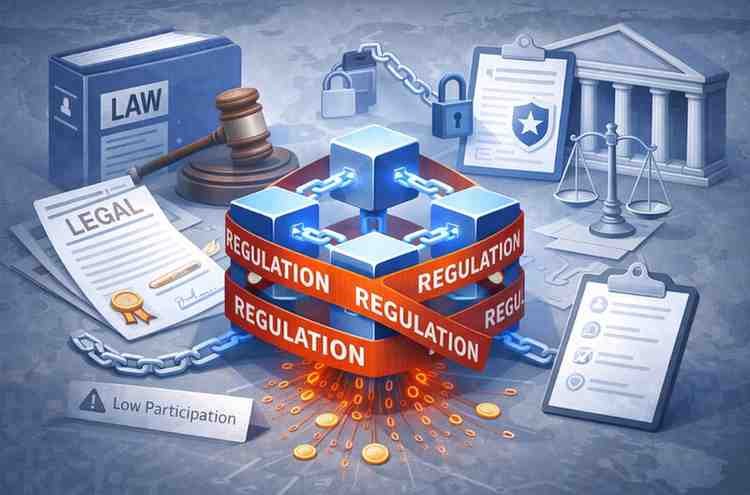
Not all failures originate in the code. Regulation plays a decisive role.
Blockchain projects operate across jurisdictions with shifting rules. Banking relationships can vanish overnight. Compliance requirements evolve faster than teams can adapt.
Some technically sound projects shut down simply because operating became impossible.
Payment rails were cut. Licenses were denied. Political pressure mounted. In these cases, technology wasn’t the limiting factor.
⚠️ Regulatory Reality Check: Projects with anonymous teams, unclear legal structures, or operations in hostile jurisdictions face existential risk regardless of technical merit. Builders should establish legal entities early, work with experienced blockchain counsel, and maintain relationships with compliant service providers. Users should consider regulatory sustainability as seriously as technical security.
Understanding regulatory risk has become an essential part of building blockchain systems.
Projects that survive engage early with legal frameworks, select jurisdictions carefully, and build flexibility into their operations.
Section 8: What Surviving Blockchain Projects Do Differently

Blockchain projects that survive share consistent patterns.
They focus on real users and measurable utility. Usage is defined not by wallet connections, but by retention and value created.
They adopt conservative, adaptable token economics. Emissions stay controlled. Incentives evolve as the system matures.
Security culture runs deep. Audits continue ongoing. Processes assume failure and prioritize containment.
Decentralization gets applied pragmatically. Systems remain upgradeable. Governance evolves over time.
💡 The Boring Success Pattern: Long-term winners often appear unexciting. They ship regular updates with minimal fanfare, maintain consistent communication through bear markets, and prioritize boring fundamentals like documentation, developer experience, and customer support over viral marketing campaigns. If a project’s social media engagement vastly exceeds its GitHub activity, that’s often a warning sign.
Most importantly, survivors are built by long-term builders. Progress continues during bear markets. Shipping never stops.
Section 9: Common Traits of Blockchain Projects That Last
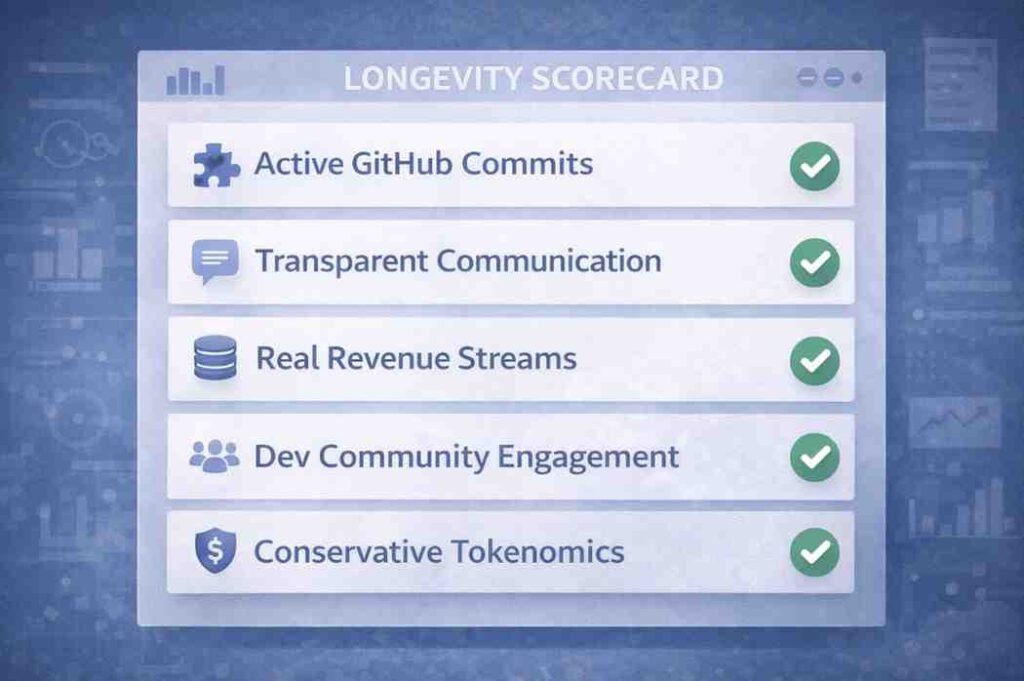
Projects that endure often appear boring compared to hype-driven launches.
Developer communities remain active even when attention fades. Communication stays transparent and consistent. Roadmaps adjust without drama.
Revenue or sustainability exists beyond token price appreciation. Fees, services, or institutional usage support ongoing operations.
Incentives align across users, developers, and stakeholders. Growth comes slower, but stronger.
🎯 Due Diligence Framework: When evaluating long-term potential, examine: (1) Team transparency and track record, (2) Real revenue or value capture mechanisms, (3) Developer activity over 6+ months, (4) User retention rates, not just acquisition, (5) Clear competitive advantages beyond “first mover” status. Combine these signals rather than relying on any single metric.
These traits rarely go viral. They compound quietly over years.
Conclusion: Survival in Blockchain Is Earned, Not Promised
Most blockchain projects fail not because the technology is useless, but because execution falls short.
Poor problem selection, fragile incentives, security failures, governance paralysis, and external pressure compound quickly. Hype may delay failure, but it never prevents it.
Blockchain success looks quieter than promised.
It’s slower. More disciplined. Less visible.
The projects that survive aren’t the loudest—they’re the most resilient.
Final Expert Advice: Whether you’re building, investing, or using blockchain technology, shift your evaluation criteria. Stop asking “How revolutionary is this?” and start asking “How sustainable is this?” Look for teams that ship consistently, admit mistakes openly, and build with 5-year timelines instead of 5-month hype cycles. The future belongs to the resilient, not the revolutionary.
So the real question for builders, investors, and users remains: Is the project you believe in built to last, or built to launch?
Share your perspective, challenge these ideas, and join the discussion. The future of blockchain will be shaped less by promises and more by what truly endures.
Read Also: Why Budgeting Feels Harder in 2026 (Even When You’re Doing Everything Right)

