




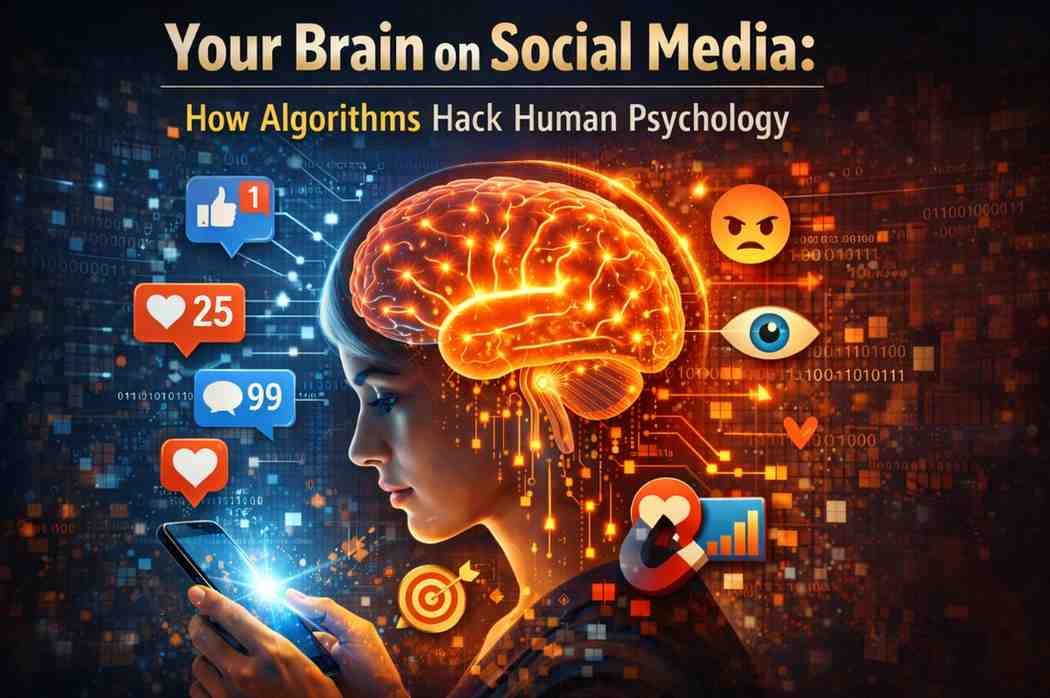
Social media feels effortless, yet every swipe is carefully engineered. Behind the scenes, algorithms study your behavior, predict your impulses, and shape what you see to keep you scrolling.
Understanding how these systems work is the first step toward protecting your attention, mental health, and autonomy in a world where persuasion is automated and always on.
What Are Social Media Algorithms and Why They Matter for Your Brain
This section explains what algorithms really are, how they work, and why they have such a powerful influence on your thoughts, emotions, and decisions.
How Algorithms Decide What You See
Social media algorithms are machine-learning systems trained to predict what will keep you engaged. They analyze thousands of signals, including likes, watch time, comments, shares, search history, device type, and even how long you hover over a post.
From this data, the platform builds a behavioral profile of your preferences and emotional triggers. Your feed is not neutral. It is a constantly updated experiment designed to test what captures your attention most effectively.
Over time, this creates a feedback loop. You interact with certain content, the algorithm shows you more of it, and your brain adapts to that pattern, reinforcing habits you never consciously chose.
Why Algorithms Optimize for Engagement, Not Wellbeing
Platforms measure success using engagement metrics such as time spent, session length, and interaction rate. These metrics directly drive advertising revenue, which means the system is rewarded for keeping you online, not for protecting your mental health.
Content that provokes strong emotion performs best. This includes outrage, fear, tribal identity, and envy. Calm, balanced information struggles to compete.
Your brain becomes the product, and your attention becomes the currency.
How Social Media Algorithms Hack Human Psychology
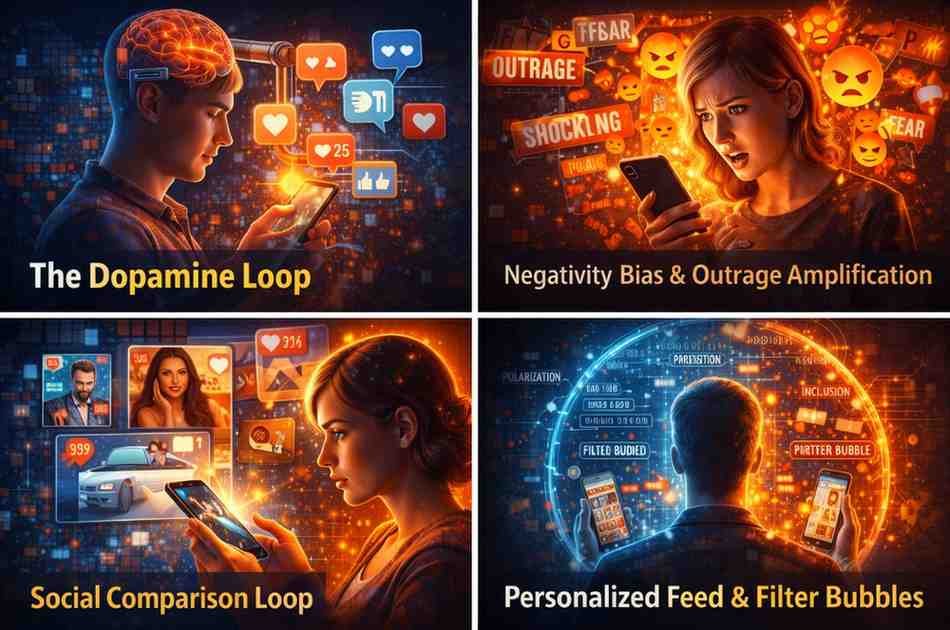
Here we explore the psychological mechanisms algorithms exploit to create habit-forming behavior and emotional dependency.
The Dopamine Loop and Variable Rewards
Every notification, like, and comment acts as a variable reward, the same principle used in slot machines.
Your brain releases dopamine when it anticipates a reward, not just when it receives one. Because you never know which post will go viral or which message will arrive, the uncertainty keeps you checking compulsively.
This dopamine loop trains your brain to seek constant stimulation, reducing your tolerance for boredom and deep focus.
Negativity Bias and Outrage Amplification
Humans are wired to notice threats more than positives. Algorithms exploit this negativity bias by prioritizing content that sparks anger, fear, or moral outrage.
These emotions drive rapid sharing and intense engagement, which the system interprets as “valuable.”
Over time, your feed becomes emotionally charged, increasing stress levels and shaping a more reactive, polarized mindset.
Social Comparison and Self-Worth Traps
Platforms highlight curated success, beauty, and wealth, encouraging constant comparison.
Your brain measures your value against what you see, even when you know it is filtered and staged.
This social comparison loop can erode self-esteem, fuel anxiety, and create a distorted sense of reality where everyone else appears to be winning.
What Happens to Your Brain When You Scroll for Hours
This section explains the neurological and cognitive effects of prolonged algorithm-driven scrolling.
Attention Fragmentation and Cognitive Load
Endless feeds condition your brain to expect rapid novelty.
Instead of sustained focus, your attention becomes fragmented, jumping from stimulus to stimulus. This increases cognitive load and reduces your ability to concentrate on complex tasks, deep reading, or creative work.
The result is mental fatigue that feels like burnout, even when you have not done meaningful work.
Memory, Learning, and Sleep Disruption
Heavy social media use interferes with memory consolidation and learning by constantly interrupting your thought process.
Late-night scrolling suppresses melatonin through blue light exposure and emotional stimulation, delaying sleep onset.
Poor sleep then weakens emotional regulation, making you even more vulnerable to algorithmic manipulation the next day.
How Personalized Feeds Reshape Beliefs and Behavior
Here we look at how algorithms influence what you think, buy, and believe at scale.
Filter Bubbles and Confirmation Bias
Personalized feeds create filter bubbles, showing you content that matches your existing views.
This reinforces confirmation bias, where your brain accepts familiar ideas as truth and rejects opposing perspectives.
Over time, your worldview narrows, making meaningful dialogue harder and extremism more attractive.
Persuasion at Scale and Micro-Targeting
Advertisers and political campaigns use algorithms for micro-targeted persuasion.
Your emotional vulnerabilities, values, and fears are mapped and used to deliver perfectly timed messages.
This turns psychology into a programmable system, influencing behavior without your awareness or consent.
How to Reclaim Control from Algorithmic Manipulation
This section provides practical strategies to protect your mind and rebuild healthy digital habits.
Practical Habits to Retrain Your Brain
- Turn off non-essential notifications to break the dopamine loop.
- Set time boundaries using app limits or scheduled offline hours.
- Curate your feed intentionally by unfollowing outrage-driven accounts.
- Practice deep work sessions to rebuild focus and attention stamina.
These small changes gradually restore autonomy and reduce compulsive behavior.
Smart Settings and Tool-Based Defenses
Use grayscale mode to reduce visual stimulation and emotional pull.
Enable chronological feeds where available to reduce algorithmic influence.
Install digital wellbeing tools that track usage and highlight behavioral patterns you may not notice yourself.
What a Healthier Algorithmic Future Could Look Like
This final section explores how technology can evolve to support human wellbeing instead of exploiting it.
Design Principles for Humane Technology
Healthy platforms prioritize user agency, transparency, and psychological safety.
They optimize for meaningful connection, not endless engagement, and provide clear explanations of how content is ranked.
When design aligns with human values, technology becomes a tool for growth rather than control.
Policy, Transparency, and User Rights
Regulation can require algorithmic transparency, data portability, and informed consent.
Users deserve the right to understand how their attention is shaped and to opt out of manipulative systems.
A healthier digital future depends on aligning innovation with ethical responsibility.
FAQ
How do social media algorithms affect the human brain?
They exploit dopamine, attention, and emotion systems to create habit-forming behavior that keeps users engaged longer.
What psychological tricks do social media algorithms use?
They use variable rewards, negativity bias, social comparison, and confirmation bias to influence behavior and beliefs.
Why do algorithms prioritize outrage and extreme content?
Outrage drives higher engagement, which increases time spent and advertising revenue for platforms.
Can social media algorithms cause anxiety and depression?
Yes. Constant comparison, emotional overload, and disrupted sleep are strongly linked to mental health issues.
How do algorithms influence political and social beliefs?
Personalized feeds reinforce filter bubbles and deliver micro-targeted persuasion that shapes opinions without awareness.
What happens to attention span with heavy social media use?
Attention becomes fragmented, reducing focus, memory, and the ability to perform deep, meaningful work.
How can I protect my brain from algorithmic manipulation?
Limit notifications, set time boundaries, curate your feed, and use digital wellbeing tools to regain control.
Will future algorithms become healthier for users?
With ethical design, transparency, and regulation, algorithms can evolve to support wellbeing instead of exploiting psychology.

